Thursday, March 02, 2006

Upcoming Pedal Ubin Ride @ 11 Mar (Sat)

Pedal Ubin is a guided cycling trip of Pulau Ubin. This 3.5-4 hour ride is suitable especially for those who are clueless about Ubin. Don't worry if you're a novice cyclist. As long as you can balance yourself on a bike, you can certainly join us!


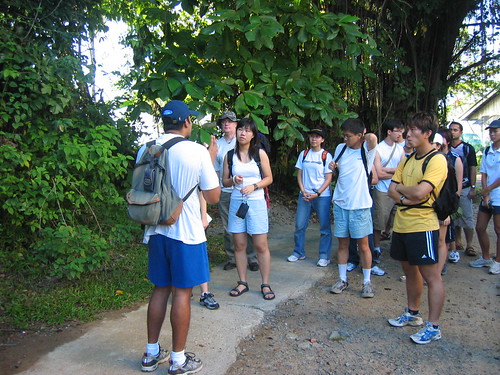
Pedal Ubin guide Gurmit in action! Photo by November Tan

More details on the Pedal Ubin website.
http://pedalubin.rafflesmuseum.net/

Time: 8am meet at Changi Point Ferry Terminal.
Cost: $10.50 (inclusive GST) per participant per ride. It goes
towards paying for the bumboat ride to Pulau Ubin and whole day
bicycle rental. It also includes a token sum to indicate your
commitment to the ride. If you are bringing your own bicycles, the
charge is $7.35 (inclusive GST) per participant per ride.
Contact: To register, email pedalubin@yahoo.com. Pre-registration is
essential. You will receive a confirmation email. Places limited. For
more details about registration.

See you there!


Taken during the Pedal Ubin guided trip for NUS USP students. Photos by November Tan

Tuesday, February 28, 2006

Moving Gods Screening @ 4 March, NLB, 2pm

If you missed the previous screening of Moving Gods in NUS, this is your chance to catch it downtown, at the National Library this Saturday!

Toddycats, Singapore Heritage Society and the National Library Board is proud to present:

Moving Gods
Date: 4 March 2006 (Saturday)
Time: 2pm - 3.30pm
Venue: Imagination Room, Level 5 National Library, 100 Victoria Street

Synopsis:
Legend has it when soldiers went to Pulau Ubin to intern a German plantation-owner after the First World War broke out, his unfortunate daughter fell to her death trying to flee. Her remains were interred by locals and a Taoist shrine was dedicated to her. Once tendered by the Boyanese, it now attracts gamblers and fortune seekers from all over Asia.

Director Ho Choon Hiong was drawn to this story, leading to the Find German Girl project, website and documentary. He then adapted Lim Jen Erh's play about the same story, Moving Gods, into a tele-movie of the same name for the Arts Central "Stage to Screen" programme.

Both Choon Hiong's documentary and movie will be screened at this event, along with Curse of Moving Gods, Evelyn Goh's documentary about paranormal incidents encountered during the making of Moving Gods. The screenings will be followed by an audience dialogue with the director.

Mark the date on your calendar and see you there!

Friday, February 24, 2006

Dangers of Granite Quarrying

As mentioned before, granite quarrying was one of the main economy on the island but not only is quarrying dangerous to the quarry workers, it is also dangerous to the residents in close vicinity of the quarries!

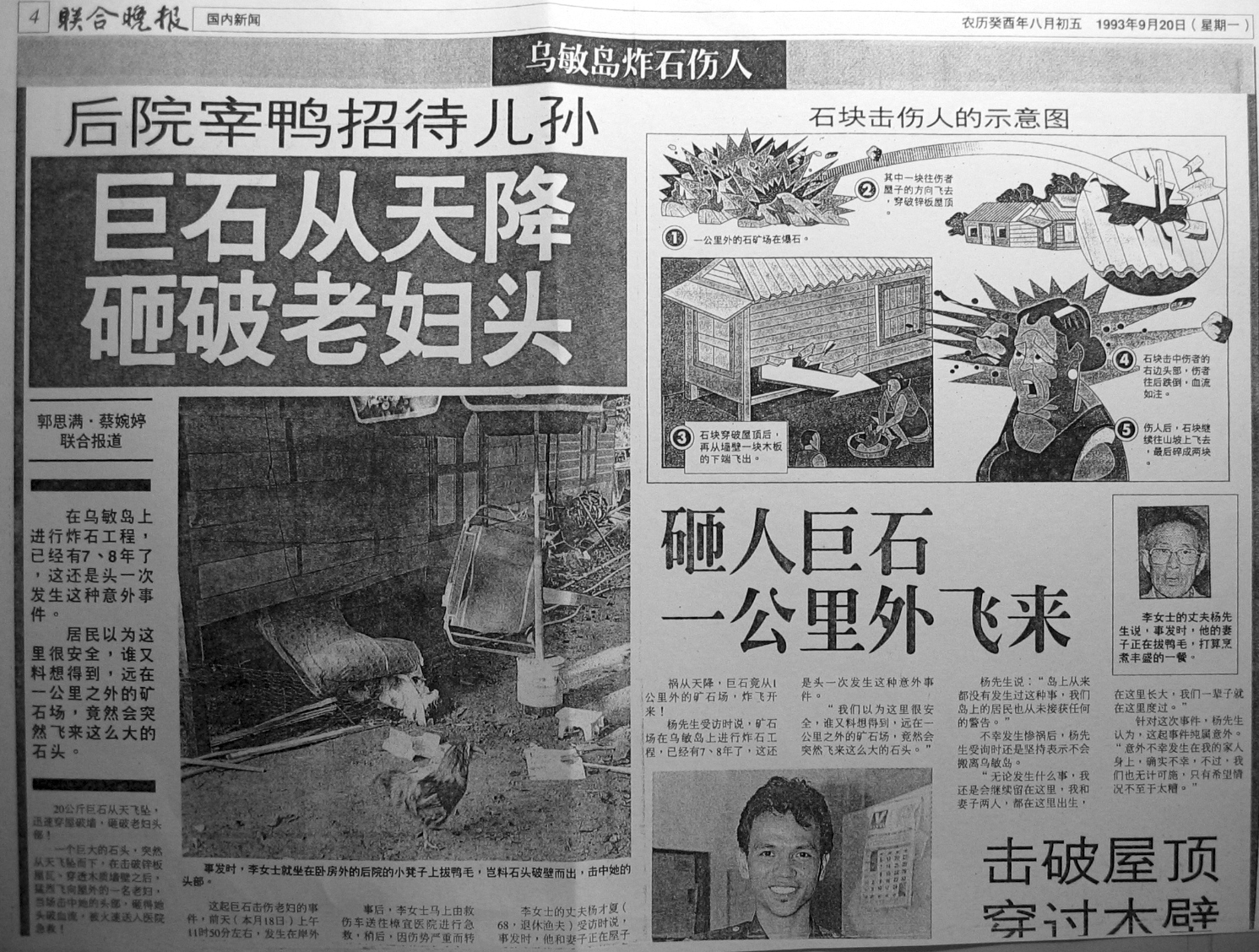
In 1993, a chinese newspaper, Lianhe Wanbao, reports of falling rocks from granite blasting on Pulau Ubin that injured an old lady.

Below is a simplified translation of the article.


Huge Rock Falls From Sky, Smashing Old Lady's Head
20 September 1993
Lianhe Wanbao
Report By Guo Si Man and Cai Wan Ting
Download the article in chinese [1MB]


A figure depicting the sequence of events: (1) A quarry 1km away was blasting granite (2) One of the bits of rock flew towards the home of the injured woman and broke through the roof (3) The boulder broke through the roof and out from under the wooden wall (4) The boulder hit the left side of the victim's head and she then fell backwards bleeding (5) After injuring the victim, the boulder still continued down the hill slope, finally breaking into two

Granite quarrying has been occuring for a while on Pulau Ubin but this is the first time such an accident has happened. Residents thought that the island was safe but unexpectedly, a loose boulder still managed to travel to as far as 1km away.

A 20kg boulder fell from the sky, flying through the walls and hitting the victim on the head. The victim was then sent to the hospital on the mainland.

This incident occured on 18 September 1993 at 11.50am. After the accident, Mdm Lee was sent immediately to Changi Hospital but due to her serious conditions, she was transfered to another hospital.

Mdm Lee's husband, Mr Yang (age 68, a retired fisherman), said that despite this accident, they will continue to stay here. His wife and him were both born on the island, grew up there and will continue to live the rest of their lives on Pulau Ubin.

He also added that this incident was purely an accident. The accident unforunately occured to his family which is very unfortunate but there is nothing they can do about it but hope that his wife's conditions is not too terrible.

Translated by November Tan

Related Stories
  • Eradication of Silicosis Problem in Singapore
  • Aerial Map of Ubin
  • Govt to develop Ubin quarry into recreational park
  • The Quarries
  • Quarry Lakes
  • Monday, February 20, 2006

    Aerial Map of Ubin


    Click to enlarge image

    Looking at this aerial photo fully illustrates the idea of Ubin being our last wild frontier. It remains largely vegetated but interrupted with gaping pools of water that are the evidence of previous quarrying activities on the island. Granite hills on the island have all been carved into the lakes which we see today.

    Lu, Wong and Chou writes in the Geology section of "Singapore's Biophysical Environment" that the granite of Pulau Ubin is part of the Bukit Timah Granite produced in early-middle Triassic age during the mountain building stage of the Malay Peninsula.

    "The Bukit Timah granite refers to a wide range of acid rocks including the assimilation of basic rocks within the batholith. Granite is the main rock, light grey in colour and of medium grain size (3-5mm). The main minerals are quartz (30%), feldspar (60-65%) and ferromagesium minerals. Hybridization occurs at its western margin and the granite gives way to granodiorite.

    The Pulau Ubin Granite has some differences from the Bukit Timah Granite. It is richer in minerals, e.g. green hornblende and brown biotite occuring in clusters. Inclusions occur commonly on Pulau Ubin and Changi, representing mainly the bodies of basic rock and these can vary from 1 cm to tens of metres."

    This granite is also one of 3 major groups of rocks that were of economic importance to Singapore in the past. A series of granite quarries were located along the western flank of Bukit Timah and on Pulau Ubin. In 1970, there were 25 granite quarries employing about 1,200 workers in Singapore. The first quarry on Pulau Ubin opened in the early 19th century and the last quarry closed in 1999.

    Source:
  • Lu Xi Xi, Wong Poh Poh & Chou Loke Ming (2005) Singapore's Biophysical Environment, Mcgraw Hill
  • Tuesday, February 14, 2006

    Duality of Pulau Ketam

    Whenever we visit the German Girl Shrine near the Ketam Quarry (previously known as Aik Hwa Quarry), we would see an islet off Pulau Ubin with a spread of tall, luscious, mature mangrove plants standing on the islet. That is Pulau Ketam.


    Pulau Ketam as seen from Pulau Ubin, in front of Ketam Quarry

    I have always known that half the islet of Ketam was administered by National Parks Board and the other half by the Agri-Food & Veterinary Authority of Singapore (AVA). However, I never knew how to differentiate the two and possibly have only ever seen this particular view of Pulau Ketam. We also joke that "the other side of the island (that you can't see) with no trees probably belonged to AVA".

    Joke aside, I had not realize the truth and severity of that statement until I saw this satellite image of Pulau Ketam, taken from Google Earth.


    Satellite image of Pulau Ketam. Source: Google Earth

    The first ground photo I showed was taken from a site at the extreme north and top of the satellite image. It is not particularly clear in this photo. The cleared area in front of AVA's side of Ketam is the Ubin Resort. Perhaps if one has stayed at Ubin Resort previously, one would have noticed the cleared side of Ketam.

    According to the Mr. Budak, during a talk on the Straw-headed bulbul of Ubin by Dr Ho Hua Chew, Head of the NSS Conservation Committee, Dr Ho mentioned:

    "Land reclamation is also changing the landscape; for instance, a part of Pulau Ketam (an islet off Ubin) has been cleared of its original mangroves and turned into a landfill for no discernible purpose."

    Dr. Ho was emphasizing on the point that these changing landscapes and clearing of forested areas on Ubin is reducing the areas where our wildlife can survive. In following weeks, I will be showing more satellite images of parts of Ubin that has been cleared for recreation. It is rather amazing to see these areas from the air as it gives scale and perspective of its dimension in relation to the rest of the island. We would never have imagined how much area it occupies when we simply cycle past it on the ground or even if we have been within its compound!

    Related Articles:
  • Changing with time
  • Living on the Edge: The Straw-headed Bulbul in Pulau Ubin