Monday, August 13, 2007

Goodbye Ubin Thai Temple

In April 2007, the Ministry of National Development announced its plans for reopening the Kekek Quarry off Jalan Wat Siam. As the road name indicates, this road was named after the Thai Temple located at the end of the road, just in front of the Kekek Quarry.

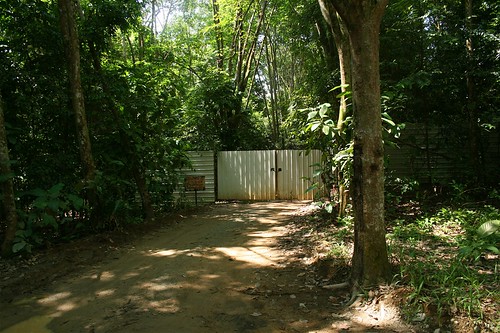
As of late July 2007, the Thai Temple no longer stands at Jalan Wat Siam, a road now devoid of its namesake.

When the announcement for the deferment of Kekek Quarry's opening came on 4 August 2007, the news was met with happiness and also frustration as yet again, a landmark on Ubin has been displaced because of planned development. Just like the Kampong Melayu en route Chek Jawa which was cleared in anticipation of the reclamation, the postponement of Kekek Quarry's opening came too late to save one of the last remaining landmarks on Pulau Ubin.
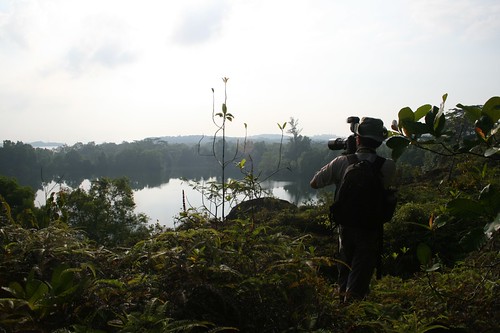

Kekek Quarry in the morning of April 7, 2007. Thai Temple is located at the foot of this hill. Photo by November

All occupants of the island must possess a Temporary Occupation Licence (TOL) from the Singapore Land Authority and it was said that the temple's license was due for renewal. While this fact needs verification, truth of the matter is that the temple is now no longer on Ubin. In an interview with one of the villagers on Ubin, it is unlikely that the temple will be issued a new TOL on Ubin even if they had applied for it after the quarry plans are shelved. It is true of course that the quarry is to be on standby, ready to be operational at the slightest need and having to relocate the temple later would be a bureaucratical hassle.
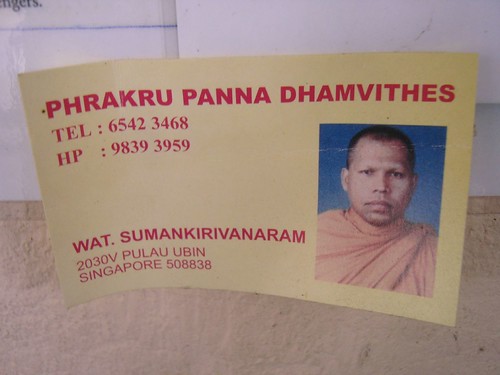

2030V Pulau Ubin is no longer an occupied address. Photo by November

The temple may seem relatively new, having only established on Ubin in 1986 when a monk from Thailand walked all the way down to Singapore and found its home here on Pulau Ubin. However, it's one of the last few remaining cultural icons on the island with large throngs of visitors on weekends and major Buddhist and Chinese festivals. This was also a large source of income for the island's taxi drivers who would ferry devotees to the temple. When asked, taxi drivers on Ubin expressed disappointment that now there is a less steady stream of income for them. Previously, they could count on major festival days to draw income from. Now, they feel Chek Jawa is the only way for them to garner income from but it is less reliable as return visitors or regular visitors are rare.
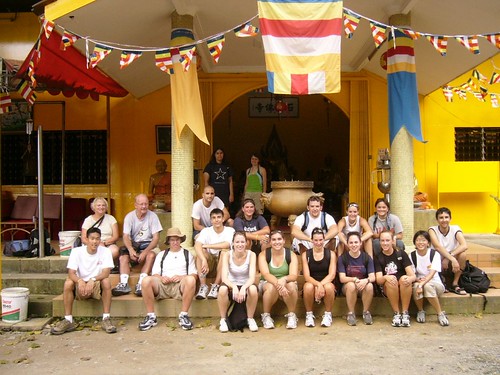

Thai Temple one year ago on July 13 2006. Who would have known a year later the temple would no longer be with us? Photo by November

A question was posted on the Ubin Forum asking where the temple has been relocated to. After some "detective work" and leg work from our guest editor, budak, we found that it has actually been moved to Jalan Kayu, near Seletar. Not very different from Ubin, Jalan Kayu is also a kampong place, still relatively undeveloped and rural but rich with heritage but under threat from urbanization and development.


Familiar idols from the Thai Temple in storage at Jalan Kayu. Photo by budak

Budak wrote:

"The reprieve granted to kekek came sadly too late for the Thai temple located within earshot of the quarry. the statues and idols no longer face a tree-lined trail and the musical tributes of straw-headed bulbuls.

The tale of the Thai temple now meets that of another Buddhist shrine, the Ban Kok Sua Chong Yee Temple that for now still resides at Seletar West Farmway 6, a small road two turns off Jalan Kayu surrounded by farmland and abandoned plots. Before secondary jungle retakes the area, however, it will likely be surrendered to planners seeking to turn this historic kampung area (see jalankayutrail.blogspot.com) into another new suburb. In a sense, it already is, as Jalan Kayu is now within a stone's throw from the Sengkang LRT network, and vast fields of cleanly cleared land (formerly farms and orchards) now link the once quiet road to a new town of HDB towers.

Now a lonely outpost in a village of ghosts and forgotten memories, Chong Yee Temple faces a dwindling lease and its custodians are currently seeking to raise funds to erect a new sanctuary for the temple's deities when the present plot is returned to the authorities.

To this end, Chong Yee Temple has linked up with the caretakers of the (former) Ubin Thai temple and another temple (dedicated to Bao Gong) to acquire a piece of land where Jalan Kayu meets Sengkang West Avenue, where a collective development will take place, with each temple maintaining its identity and management, while occupying its own portion of new worship complex.


Site of the new temple premise. Photo by budak

The artefacts of the Thai temple are now at a temporary building at the site, with an interim altar and shrine being built, which is scheduled to be ready by 22 August. Stay tuned for more updates when we visit the place after it opens."
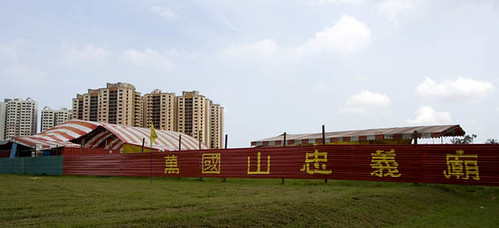
See more photos of Chong Yee Temple and the new Thai Temple premise in Budak's flickr set.

Saturday, August 04, 2007

Kekek Quarry will not be reopened yet!

Just received word that the Ministry of National Development has decided to defer the opening of Kekek Quarry in the north of Ubin. Although the government has momentarily withheld all immediate plans to extract granite from the quarry, the quarry will still be retained as a stockpile, ready for extraction and activation at any moment's notice.

MND and the Building and Construction Authority (BCA) released a media statement on the following this afternoon on 4th August 2007:

GOVERNMENT DEFERS QUARRYING GRANITE IN UBIN

Update on the granite supply situation
The Granite supply situation has improved significantly over the last one to two months. There is adequate granite supply coming in from both nearby and near distant sources in the region. As a result of this diversification of supply, there has not been any drawdown from the national stockpile from May. Prices of these materials have also moderated and stabilised.

Quarrying at Pulau Ubin
In April this year, the Government announced plans to carry out limited quarrying works at the Kekek Quarry in Pulau Ubin. Over the past few months, we have carried out preparatory works for reactivating the Kekek Quarry. These included carrying out an environmental impact study, conducting water quality tests and regulatory reviews.

Having gained useful experience and a better understanding of the process for reactivating a quarry, and as the industry is able to diversify and import adequate granite from many sources, we have decided that there is no need to commence the physical extraction of granite from the quarry for the time being.

However we are still keeping all our options open, including reactivating our own quarries if necessary. The reactivation of our local quarries remains a part of our contingency plan to ensure supply resilience of essential construction materials.

This is an absolutely wonderful piece of news to brighten up my Saturday. Perhaps this is an indication that our government is moving towards a more environmentally-sound ideology that without serious pressures, they would not choose development over our environment. In another words, they would think before they hack and rather conserve than to destroy and develop blindly for the sake of national security or economic growth. When the minister of state for MND said that they are trying to do whatever they can to prevent this from happening and that reopening the quarry was truly their last option, I suppose she actually meant it.

The skeptic amongst us would say that perhaps this was just a pragmatic decision and at the same time soothe some ruffled feathers. Or even perhaps producing is more expensive than buying. Either way, there is hope yet.


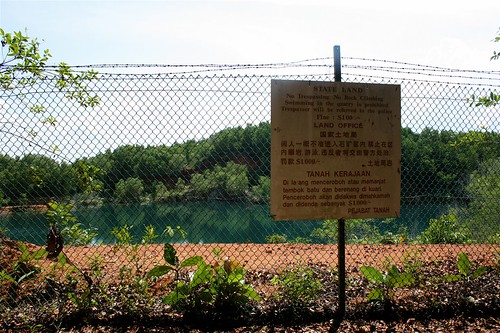
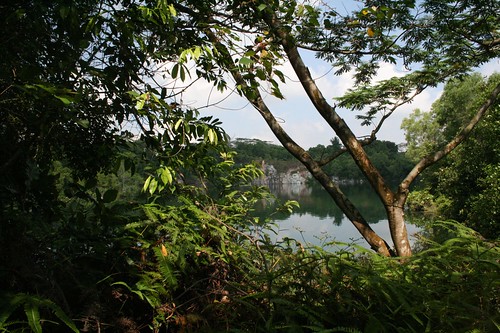
Kekek Quarry through the looking grass: taken just after the announcement to reopen quarrying in April 2007

Of course this is a delightful piece of news as the quarry and Ubin itself has escaped the fate of being a mining outpost again. However, like all things in Singapore, there is no certain fate and we should always be prepared to lose the quarry to our country's needs again.

As in all things nature conservation in Singapore, we should remember not to be complacent. Especially with change being a constant and regular feature in Ubin and every where else on this island state we live in, at any moment's notice, things which we think are here to stay may be taken away from us the next minute due to national needs.

A good example is Chek Jawa. While we are all happy that reclamation at Chek Jawa was deferred, this was only for 10 years or up till there is need for it again. It has already been 6 years since the deferment was announced and before we knew it, half our time with Chek Jawa has already flewn by! What more, whole villages were displaced to make way for reclamation at Chek Jawa and even after deferment, a piece of our history and heritage was gone already. Likewise, there has been rumours that the Thai Temple near Kekek Quarry is to relocate due to reopening of quarry. Now that quarrying has been deferred, this monkey shall go find out if the temple will really be relocated.


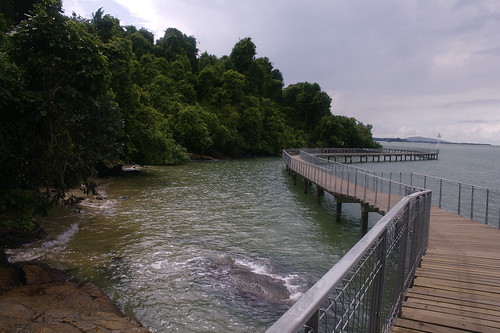
Chek Jawa Boardwalk amidst the beautiful coast line of Ubin

If we wish to hold on to these beautiful places like Chek Jawa, we should all show our love for for these places by visiting it, sharing it with our friends and of course, be generous with our words and tell everybody about it. What more, with the opening of the Chek Jawa Boardwalk, it has never been easier to get to know the area better.

I cannot be more happy to know that many Singaporeans enjoyed the Kekek Quarry very much and went to see it for the last time when it was announced to be reopened for mining. Now, it's here to stay for a while longer, we can once again go and enjoy its beautiful and serene landscape!


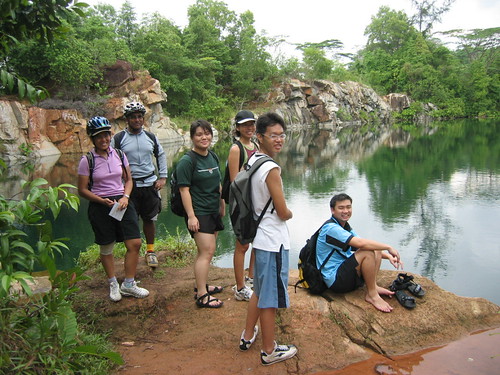
Pedal Ubin guides and participants enjoying Kekek Quarry in June 2005

Saturday, July 07, 2007

35 new plant and animal species recorded in Singapore

07 July 2007 2312 hrs
ChannelNewsAsia

SINGAPORE: National Development Minister Mah Bow Tan said 35 new plant and animal species have been recorded in Singapore in an ongoing two-year survey by National Parks and its volunteers.

Seven other species, thought to be extinct, have also been rediscovered.

And now, nature lovers can go on DIY tours of the Chek Jawa Wetlands on Pulau Ubin after new facilities were launched by Mr Mah on Saturday morning.

These facilities include a visitor centre with a viewing jetty, a boardwalk and a viewing tower.

Altogether, S$7 million have been invested by the government to protect the fragile eco-systems at Chek Jawa.

Environmentally friendly features have also been integrated into the designs, such as energy-efficient lights, motion sensor lights and solar-powered battery cells.

Reclamation plans on Chek Jawa were put on hold in 2001, following appeals by nature lovers.

Since then, more than 20,000 people have visited it.

Significant care was taken to ensure construction work on the new facilities did not affect the wildlife there.

Mr Mah said: "During the conversion of the former British cottage into the visitor centre, extra care was taken to protect a family of rare Malayan False Vampire Bats that had made the old watch tower its home for many years.

"To protect these bats, the old watch tower was left untouched and a new one was constructed. A family of Pouched Tomb Bats was also found roosting in the chimney of the cottage. Work near the chimney was carried out with extra care. I understand that both species of bats are still around."
- CNA/so

Saturday, June 09, 2007

"Ten cyclists injured each month on Pulau Ubin's 'danger spot'"

Ten cyclists injured each month on Pulau Ubin's 'danger spot'
Channel NewsAsia, 09 Jun 07

SINGAPORE: From falling tree branches to falling cyclists at Pulau Ubin - each month at least 10 cyclists get hurt while negotiating a particularly tricky spot on the rustic island.

Two weeks ago, radio DJ Zhou Chong Qing was sent flying to the ground while on his way down a slope in front of Belatok Hut.

"When I came down from here, the speed was very fast. So when I pressed the brake, I just flew off the bicycle, and I broke two bones from my left arm, and I scratched myself and I broke four teeth. And also the bicycle scratched me at the right side of my body," says Zhou.

Those familiar with the spot say over 10 accidents occur here each month. In fact, in just 10 minutes, Channel NewsAsia spotted two cyclists almost falling off their bicycles. This is despite warning signs that had been put up some 10 feet away from the danger spot.

But the rugged slope is not the only issue here - operators of bicycle rental kiosks here say Singaporeans rarely rent protective helmets!

"Caucasians are more aware of the safety aspects of things, so they are willing to pay $2 a day, compared to locals. Especially in this area here, it's a bit hilly you know, it's not like Singapore roads also," says Chan, Bicycle Rental Kiosk Operator.

Adventure-seekers are advised to be more aware of personal safety needs to maximise their thrills - minus the spills! - CNA/yy

Sunday, June 03, 2007

Pedal Ubin on 2 June 2007


Pedal Ubin guides and 2 participants after a satisfactory ride

Yesterday was the first Pedal Ubin held this year as from now on, the event would be a quarterly affair. More than 40 participants turned up although many more actually signed up for the event. However, the smaller number made each group more intimate and personal.


The Balai Quarry near Chek Jawa at Northeast Ubin

My group consisted of 3 guides and we took on the east route towards the Malay kampong and went as far as the gates of Chek Jawa. It was the second time I took the route and the first time I actually cycled to Chek Jawa. It was a breezier ride than I expected and the first time I glimpsed sight of Balai Quarry near Chek Jawa. If there was a stamp for every quarry one visits on Ubin, I'm happy to report that I would have collected the entire set! I've now seen all of the quarries and each one just as spectacular.


The gates of Chek Jawa, due to be opened soon

The boardwalk at Chek Jawa is due to open soon, possibly in July, and I await with much anticipation. Next time we would be able to cycle all the way to Chek Jawa itself and visit the boardwalk.


Remnants of a previous house at the Malay Kampong

Still this ride to the east is a rare chance for casual visitors to see things that one would usually not see on Ubin! This includes the old Malay Kampong that was resettled to make way for the reclamation at Chek Jawa and the southern shoreline of Ubin. Sadly, since reclamation was defered, what change has been made cannot be undone.


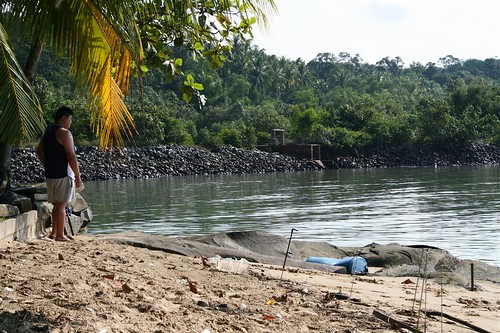
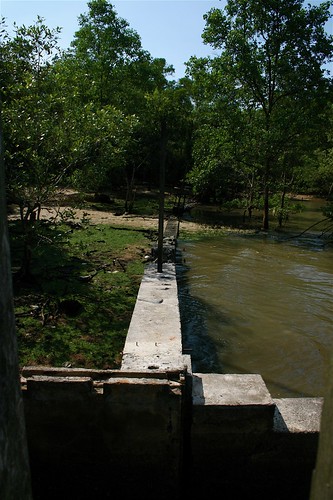
The little bit of brick longkang sticking out of the shoreline is what remains of Sungei Ubin and the mangroves beside it are all young'uns

Houses were not the only things that were removed. What more, entire shoreline of mangroves were also removed to make way for prawn farms at Sungei Ubin since it was thought to soon make way for reclamation. However, since deferment, it would take another 50 years before the mangrove would regain its previous majesty.


Yet all is not lost, despite Sungei Ubin being reduced to a small opening controlled by sluice gates, chek jawa like intertidal areas were spotted at low tide. A giant mudskipper happily swam by when it heard my enquiring for its appearance.


I also finally encountered the tallest tree on Ubin - the Pulai Tree on the way to Chek Jawa - for the first time! After always trying to photograph it from out at sea, its height did not fail its reputation upclose. Interestingly there is also a malay grave at the foot of the tree! This must be a sacred tree indeed.


Chek Jawa on the left with the boardwalk being seen visibly extending out from shore and Pulau Sekudu can be seen as a little islet on the right. The tallest tree, Pulai tree can be seen sticking out from the canopy on the left of the picture.

At low tide, Pulau Sekudu, the frog island, was also spotted clearly and the new boardwalk at Chek Jawa could be easily seen. This surely brought on much anticipation in this monkey. For more photos of the 2nd June 2007 ride to the east, visit my flickr set.